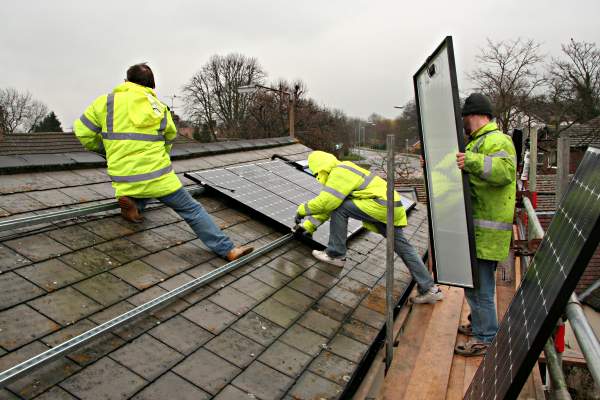
 Chelsfield Solar fitting panels (in the rain!)
Solar photovoltaic (PV) panels generate electricity, which of course you can then use for all the normal things electricity is used for. They are still expensive to buy in the first place, but there's no reason why should shouldn't have a long service life. An installation covering most of a house roof, and pointing south (or somewhere between south-east and south-west) should be capable of producing a good proportion of typical domestic demand for electricity.
Of course, they don't always produce the electricity when you want it. For example, none is produced at night, and because of the large seasonal variation at my latitude, 52 degrees north, you might get 5 times as much energy produced during a sunny mid-summer day, compared to a sunny day in mid-winter.
Installation of solar-PV panels (apart of course from fixing to the roof) is a simple electrical wiring job. Normally a new circuit going back to the meter or fusebox is needed.
As I said above, the panels don't always produce the energy when you need it. Which gives
two choices:
An on-grid system will only work when the grid itself is working. So if there's a power cut, you won't be able to use the energy from your solar panels. Power-cuts seems to be rare for the time being, but if the energy-crisis means that they become commonplace, then that might be the time to look into an off-grid battery alternative.
Solar PV panels are sold by the kWp (kilowatt peak). This is the power that they would produce under some standard conditions, which correspond approximately to full sun. My own system is 2.1kWp, and I've seen it producing just over 2.1kW of power in good conditions. The panels work best when it's cold, so might not always be at their peak on a hot summer day. A cold sunny day suits them better!
For this part of the England (near Cambridge), it's well known (from expected amount of sun, etc.) that 1kWp of panels will, over a whole year, generate about 900kWh of electrical energy (typical household usage is said to be 3300kWh, though this is greater than my own usage).
My system was predicted to generate 1850kWh over a year, and in the several years I've had it now tends to exceed this, perhaps producing around 1900kWh.
Solar PV panels are expensive to buy. A decent-sized grid-connected system is unlikely to cost less than £10000. Until 2009, there was the possibility of a £2500 grant towards it, as mentioned on my page about solar panels in general, but this type of grant has now been cancelled in favour of paying a "Feed-in Tariff" for the electricity you generate.
Who knows how much electricity might cost in the future? It's certainly been increasing at a phenomenal rate recently, so the solar panels might yet prove a valuable investment. This used to be something that you had to 'want to do' (for the environment, or whatever), rather than necessarily expecting a payback, but since the introduction of the Feed-In Tariff, ir can be considered as an investment like any other.
My electricity supplier Ebico, whose supply/billing actually comes from Southern Electric, used to (June 2009) pay me 28p per kWh of electricity exported, which I think was a premium above what anyone currently pays for electricity. Ebico also have extremely good rates for supplying electricity, so I think I'm doing well both ways with them. Unfortunately the Feed-In Tariff, introduced from April 2010, was crafted by the then government so as to penalise early-adopters such as myself, and I now only get 9p/kWh for everything I generate, and 3p/kWh for anything exported. People installing from new get a much more favourable rate. The new government elected in May 2010 indicated that they might change the regulations so as to treat early adopters fairly, but they then failed to do it. Rather perversely, the Feed-In Tariff provides little incentive to export surplus electricity - you're better off if you can manage to use it on-site (so long as you don't just waste it).
The feed-in tariff in the UK promises an index linked payment per kWh generated for a period of 25 years. The starting amount (before index-linking) is fixed at the time you sign up, and is scheduled to reduce each year, as the technology gets cheaper to install.
The starting point when the scheme was launched in April 2010 was over 40p/kWh. Although a review (and possible reduction) was scheduled for April 2012, it was suddenly announced in November 2011 that the payment for systems with an 'elibibility date' of 12-Dec-2011 or later would be cut by around 50%. This caused chaos in the solar industry, with shortages of components, due to the rush to complete installations which had already been planned. It's strange that the cut-off date comes before the completion of the so-called 'consultation' on this which the Department of Environment and Climate Change are running, leading to some legal challenges. So it's still possible that the cut won't happen (at least until April 2012), but it seems very likely that it will.
After some researching on the web, I chose Chelsfield Solar of Hemel Hempstead to do my installation. They seemed to be competent friendly people. I doubt that there is too much variation between difference installers though - the main cost is the panels themselves.
There are some pictures below, and also I produce Live graphs of output from the PV panels.
Chelsfield Solar fitting panels (in the rain!)
You can see the solar thermal panel at the far end of the roof.
The panels are made by Sanyo, and are 210Wp each.
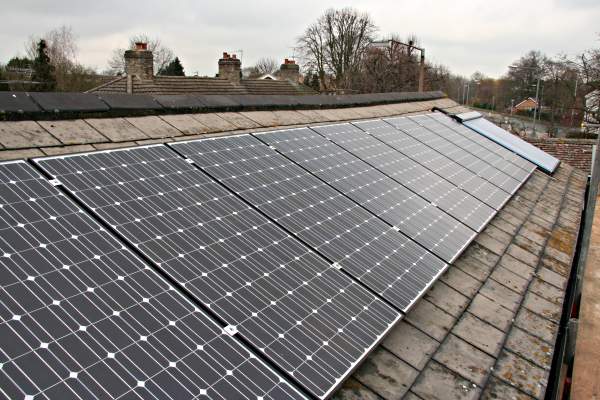 All panels now in place
You can see 9 out of the 10 panels in this picture, and again the solar thermal panel
at the far end.
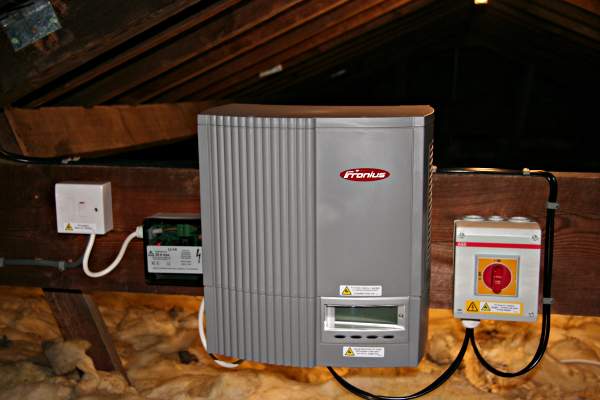 Inverter in the loft
Here's the inverter and several switches up in the loft. This converts DC from the panels
into mains AC.
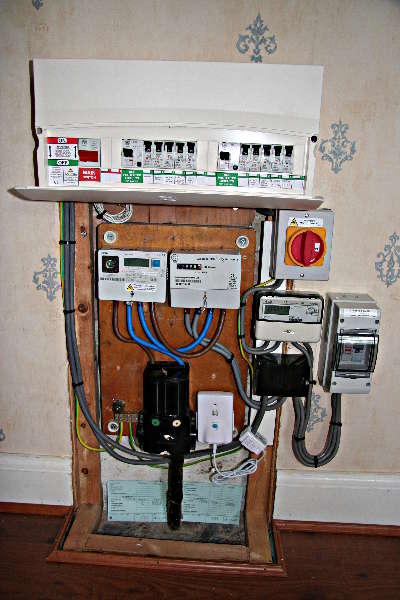 Meter cupboard
Here's the meter cupboard area (before I got a new cupboard around it all!).
You can see 3 meters in total:
The reason for the 'total generation meter' is that (pre-2010) OFGEM used to issue 'renewable
obligation certificates' (ROCs) for each unit of renewable energy which is generated.
Electricity supply companies are obliged to generate an increasing proportion of
their power from renewable sources. If they fail to do so, they can buy these
certificates to cover the shortfall, so the certificates have a value on the market.
It's (June 2009) around 8p/kWh, so depending on what scheme you are on, it's possible to
be paid for generating renewable energy even though you then used it up yourself. With the
introduction of Feed-in Tariffs from April 2010, then you are paid mainly on the basis of
everything you generate, with only a small payment for anything exported.